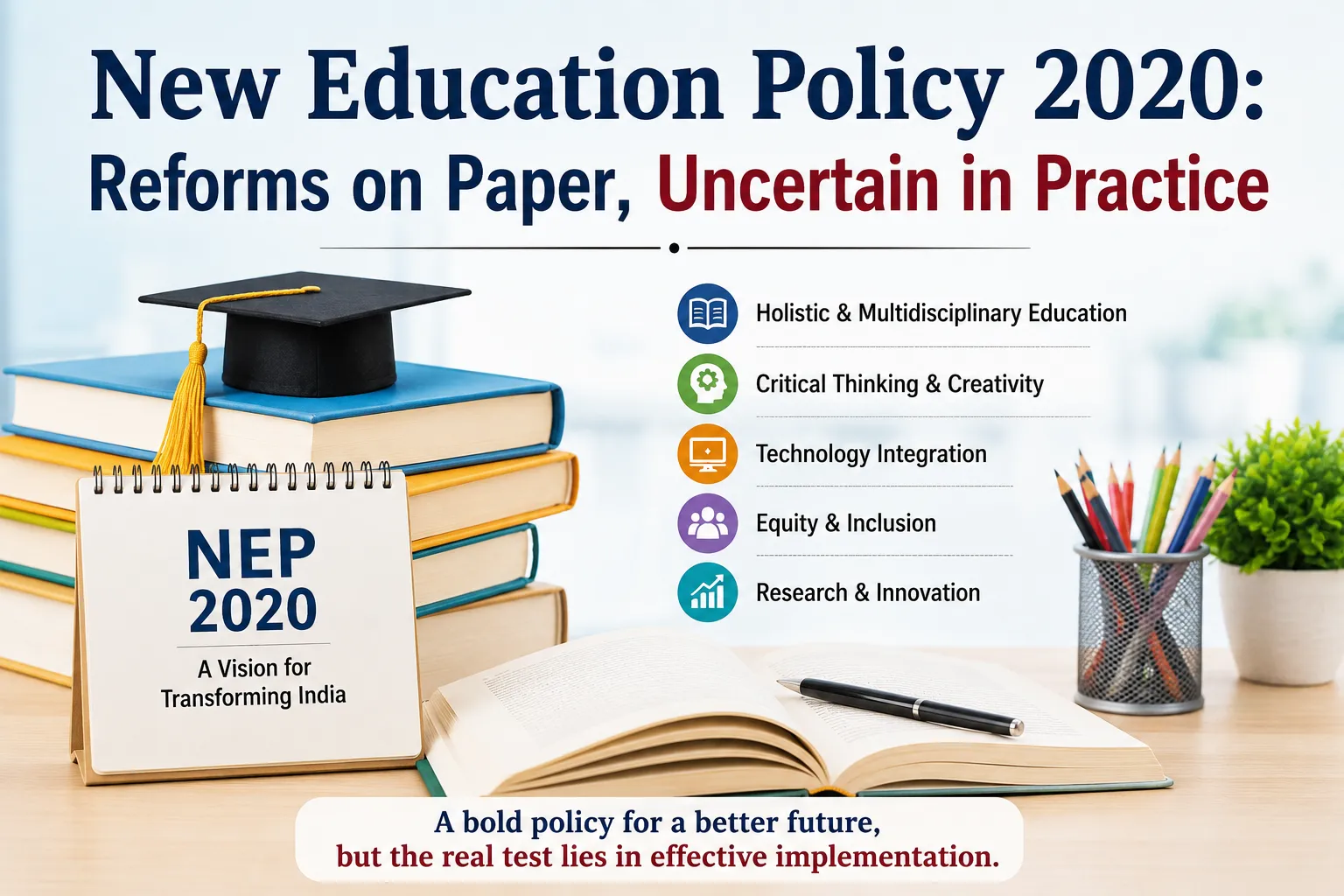
New Education Policy 2020:
Reforms on Paper, Uncertain in Practice
Dr. R. K. Uppal, Professor Emeritus [PhD, D.Litt.]
…………………………………………………………
The National Education Policy (NEP) 2020 was unveiled with great optimism and was widely regarded as one of the most significant educational reforms in independent India. Replacing the National Policy on Education of 1986, the new policy sought to address the challenges of a rapidly changing world and prepare India for the demands of the twenty-first century. It promised to transform the educational landscape through multidisciplinary learning, skill-based education, research excellence, digital integration, and greater institutional autonomy. The policy generated excitement among educators, policymakers, students, and parents alike. However, nearly six years after its introduction, an important question continues to be debated: Is NEP 2020 delivering meaningful change on the ground, or does it remains a visionary document whose implementation falls short of its ambitions?
There is little disagreement that the policy's vision is both comprehensive and forward-looking. It seeks to move away from the traditional model of rote learning and examination-driven education toward a system that emphasizes critical thinking, creativity, innovation, and problem-solving. The policy recognizes that education must equip students not only with knowledge but also with the skills required to thrive in an increasingly competitive and technology-driven world. One of the most celebrated features of NEP 2020 is its emphasis on multidisciplinary education. Students are encouraged to pursue subjects across different disciplines rather than being confined to rigid academic streams. This flexibility is expected to create graduates with broader perspectives and diverse skill sets. The introduction of multiple entry and exit options in higher education and the Academic Bank of Credits further aims to make education more flexible and student-friendly.
The policy also places considerable emphasis on research and innovation. For decades, India has struggled to establish itself as a global leader in research despite having one of the world's largest higher education systems. NEP 2020 attempts to address this issue through the promotion of research culture and the establishment of the National Research Foundation. The objective is to improve research quality, encourage innovation, and strengthen India's knowledge economy. Despite these commendable objectives, the real challenge lies in implementation. Educational reforms are judged not by the quality of their vision but by their ability to produce tangible outcomes. In this regard, NEP 2020 faces several obstacles that threaten to limit its effectiveness.
A major challenge is the vast disparity in educational infrastructure across the country. While some urban institutions possess advanced facilities and qualified faculty, thousands of colleges and schools in rural and semi-urban areas struggle with inadequate classrooms, outdated laboratories, insufficient libraries, and limited technological resources. Implementing multidisciplinary education, skill development programmes, and research initiatives requires substantial investment in infrastructure. Without such investments, many institutions will find it difficult to translate policy goals into practical reality.
“The issue of faculty preparedness is equally significant. Teachers play a central role in educational transformation. The success of NEP 2020 depends upon educators who can adopt innovative teaching methods, integrate technology effectively, promote critical thinking, and guide research activities. Unfortunately, many teachers have not received adequate training to meet these expectations. Faculty development programmes remain uneven across institutions, and shortages of qualified teachers continue to affect many regions. Unless teachers are empowered through continuous professional development, the policy's objectives may remain largely unattained.”
Another area of concern is the digital divide. NEP 2020 strongly advocates the use of technology in education. The COVID-19 pandemic further accelerated the shift toward digital learning and highlighted the importance of technological integration. However, millions of students across India continue to face barriers related to internet connectivity, access to digital devices, and technological literacy. Rural and economically disadvantaged students are particularly affected. While digital education offers tremendous opportunities, it also risks widening educational inequalities if access remains uneven. Financial constraints present another serious challenge. The policy recommends increasing public expenditure on education to 6 percent of GDP, a target that has been discussed for decades but rarely achieved. Educational transformation requires significant financial resources for infrastructure development, teacher training, research funding, scholarships, and digital expansion. Without sustained financial commitment from both central and state governments, many of the policy's ambitious proposals may remain aspiration rather than operational.
Higher education institutions also face difficulties in adapting to the structural reforms envisioned by NEP 2020. The introduction of multidisciplinary programmes, flexible degree structures, and credit transfer mechanisms requires extensive administrative restructuring. Many universities and colleges lack the institutional capacity to implement these reforms efficiently. As a result, progress has been uneven, with some institutions moving ahead rapidly while others struggle to keep pace. The policy's focus on research excellence is particularly important for India's future. A nation aspiring to become a global economic and technological power cannot rely solely on teaching-oriented institutions. It must also cultivate a robust research ecosystem. However, research in India continues to face numerous challenges, including inadequate funding, bureaucratic hurdles, limited industry collaboration, and insufficient incentives for high-quality scholarly work. While the National Research Foundation has the potential to improve the situation, meaningful progress will require sustained investment and long-term commitment. Rural colleges face perhaps the greatest difficulties in implementing NEP 2020. Many such institutions already struggle with declining enrolments, financial instability, and faculty shortages. The transition toward multidisciplinary education and research-oriented learning demands resources that many rural colleges simply do not possess. Without targeted support, these institutions risk falling further behind, thereby widening regional disparities in higher education.
Ultimately, the future of NEP 2020 depends on whether India can bridge the gap between aspiration and execution. Policies alone cannot transform education. Real change requires adequate funding, strong leadership, institutional capacity, teacher empowerment, technological access, and continuous monitoring. The policy provides a roadmap, but the journey requires sustained effort and commitment. NEP 2020 has the potential to reshape India's educational future and strengthen its position in the global knowledge economy. However, unless implementation challenges are addressed decisively, it risks becoming a remarkable vision that achieved far less than it promised. The true success of the policy will be measured not by the promises it made but by the educational transformation it delivers in classrooms, colleges, universities, and communities across the nation.