Calls it successful example of ‘Make in India’
Modi dedicates Rs 5470 cr worth projects in Punjab
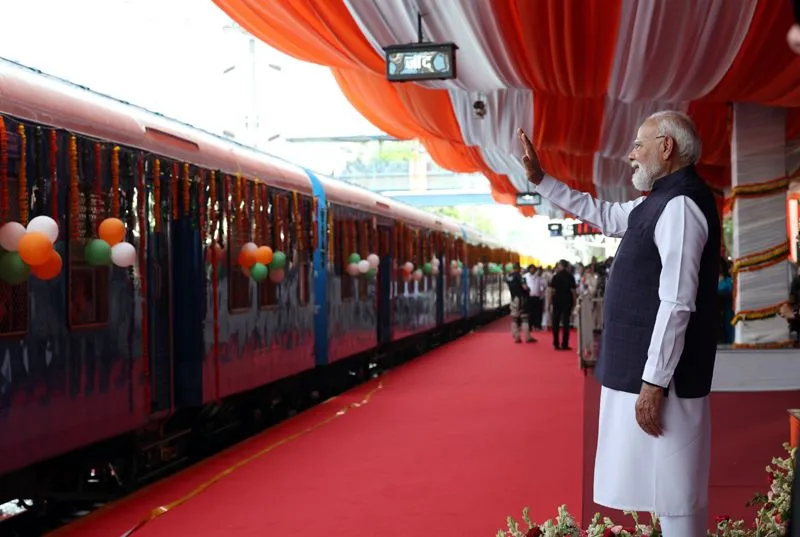
JIND (Haryana), July 17: Prime Minister Narendra Modi on Friday flagged off India's first hydrogen-powered train connecting Jind and Sonipat in Haryana, calling it a major leap towards green mobility and a successful example of the 'Make in India' campaign.
With this, India has joined a select group of countries that have operational hydrogen-powered trains and marks an important step towards the adoption of clean and sustainable mobility in the railway sector.
After flagging off the train from Jind, the prime minister also dedicated to the nation and laid foundation stone of various development projects worth Rs 14,700 crore.
Modi said the hydrogen-powered train is a proud symbol of Aatmanirbhar Bharat and our commitment to cleaner, future-ready transportation.
Today, Indian Railways has taken a major step and this is the world's most powerful hydrogen train, he said addressing a public gathering later.
The 89-km distance between Jind and Sonipat will be covered in two hours, with the train halting at 12 intermediate stations.
Modi also took a veiled dig at the previous Congress-led UPA government, saying had the situation due to West Asia conflict arisen before 2014, the work of Indian Railways would have come to a standstill as trains in large parts of the country used to run mainly on diesel.
"At that time, in large parts of our country our trains used to run on diesel only. Had diesel supplies been disrupted then, how would diesel-powered trains have operated? The country would have faced a massive crisis. But friends, this is not the situation of 2014. It is Modi, who thinks well before and also turns solutions to problems into reality on the ground," he said.
Referring to the West Asia conflict, Modi said, "You are seeing that for past several months, war has been going on in West Asia, across the entire region of (Strait of) Hormuz, involving Iran, and the Gulf. It is through this sea route through Hormuz that India receives a huge quantity of petrol, diesel, LPG gas, and fertilizers for our farmers. But for the last three to four months, this route has continuously remained a battlefield, surrounded by crisis."
He said Indian Railways has taken a big step in this 21st century technology as only three to four countries have the capability of running hydrogen-powered train.
This train has 3200 horsepower and it is not only the most powerful, but also the longest one (10 coaches), Modi said.
"At other places in world, hydrogen train has three to four coaches only. But in India, this train has 10 coaches," he said.
By running a 10-coach hydrogen train, India has established its presence in the world (janda gaad diya hai), he said.
"Here in Jind, all such things have been made for it. In coming time, more infrastructure connected with hydrogen train will be made. New factories will come up which will meet the need of hydrogen train network. This will generate new avenues of employment for Haryana youths," he said.
Recalling his association with Jind, he said, "I cannot forget the love I have got." Jind's 'ghee' and 'ghevar' have not changed in years but its 'tevar' (attitude) has, he said, adding Jind is becoming a model of the BJP's and the NDA's good governance.
Names of Jind, Sonipat and Haryana will come up whenever there is mention of hydrogen train, I congratulate the entire country, he added.
During his speech Modi also made a mention of 'Swachhta Se Swagat' (welcome through cleanliness) campaign in Jind which had been going on for past few days ahead of his visit.
"I will praise the people of Jind and Haryana for enthusiastically taking part in this Swachhta campaign. During the past one week, there is a lot of discussion going on about the campaign," he said.
He urged the people to make Swachhta a part of nature, their value system and an integral part of their daily lives.
After flagging off the hydrogen-powered train, Modi dedicated to the nation and laid the foundation stone of development projects worth Rs 14,700 crore, giving a boost to road connectivity, healthcare and strengthening cultural heritage.
Among these projects is the 157.92 km long four-lane, fully access-controlled Delhi-Amritsar-Katra Expressway which has been developed at a cost of around Rs 9,680 crore.
He also inaugurated the 33.81 km four-lane, partially access-controlled Ambala-Kala Amb Highway on NH-7 and NH-344.
Among the other projects, the prime minister laid the foundation stone of a Sikh museum at Kurukshetra that will showcase the history of Sikhism, the teachings of Sikh Gurus, their courage, sacrifices and the invaluable contribution of the Sikh community to India's civilisation.
Modi said this is the land of Jind, associated with the glory of Maharaja Ranjit Singh as well as the faith linked to the Pandavas.
"India of today not only preserves this legacy but is also committed to passing it on with pride to future generations. With this spirit, the foundation stone of a Sikh museum has been laid in Kurukshetra today. This new museum will further enrich Haryana's cultural landscape," he said.
Meanwhile, Prime Minister Narendra Modi on Friday inaugurated and laid the foundation stone of rail and road infrastructure projects, including 75 redeveloped railway stations, worth Rs 5,470 crore from Jalandhar.
The projects are aimed at strengthening connectivity, improving passenger convenience and accelerating economic development in the region.
The Prime Minister also flagged off the Amritsar (Chheharta)-Varanasi Sant Ravidas Express, establishing a direct rail link between two revered spiritual and cultural centres.
Modi reached Jalandhar after unveiling projects in Chandigarh and Haryana's Jind where he flagged off India's first hydrogen-powered train.
This is his second visit to Jalandhar after he visited the Dera Sachkhand Ballan in February this year.
Modi's visit is being seen as political outreach ahead of the 2027 Punjab Assembly polls, which the BJP is preparing to fight on its own.
The prime minister inaugurated 75 redeveloped railway stations in 20 states under the Amrit Bharat Station Scheme. Modern, passenger-friendly facilities have been added to the stations, which have been redeveloped at about Rs 1,570 crore.
Four among them are in Punjab: Jalandhar Cantonment, S A S Nagar (Mohali), Sri Muktsar Sahib and Sri Anandpur Sahib railway stations.
Elements reflecting local culture, heritage and architecture have been incorporated at the stations.
Modi also inaugurated the Daulatpur Chowk-Kartoli new rail line, constructed at about Rs 830 crore as part of the Nangal Dam-Talwara-Mukerian New Rail Line Project.
This project will significantly strengthen rail connectivity between Punjab and Himachal Pradesh, benefiting the districts of Hoshiarpur and Una, officials said. The new rail line will provide connectivity to important religious destinations such as Shri Anandpur Sahib and Maa Chintpurni Temple, while enhancing access to remote areas by providing passengers with a faster, safer and more reliable mode of transportation, they said.
Modi also flagged off the Kartoli-Ambala train service, which will improve connectivity across Punjab, Haryana and Himachal Pradesh.
He also flagged off the Sant Ravidas Express, establishing a direct rail link between Amritsar and Varanasi. After arriving in Jalandhar, Modi was also seen with Sachkhand Ballan Dera chief Niranjan Dass at the Jalandhar Cantt railway station.
It has been the major demand of the Ravidassia community in Punjab for a direct train service ahead of Guru Ravidas's 650th Parkash Purab celebrations at his birthplace Seer Govardhanpur in Varanasi. (PTI)