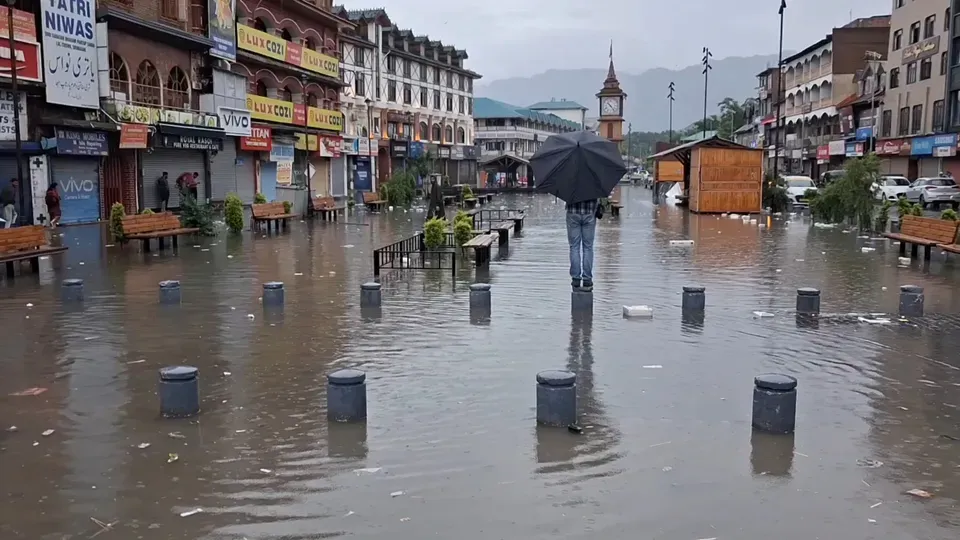
Srinagar, Jul 23: Every spell of intense rainfall in Srinagar reignites criticism of urban infrastructure projects and the Smart City initiative often finds itself at the centre of public agony. But experts say the city's flooding is not about Srinagar Smart City Project Limited, but a basic flaw in what goes into Srinagar’s drains. It is a multi-layered story of systemic failures, and public apathy, and how it endangers the city and its water bodies.
Water-logged Srinagar is a new reality on any stormy day now. Public discourse has linked these changes to SSCL, alleging that drains and pumps that came up across Srinagar under the project fail to dewater most areas fast enough to prevent public agony and financial losses.
Former Chief Engineer of Srinagar Smart City Limited, Iftikhar Kakroo, said the facts are contrary to this public perception.
He said the city's drainage network was designed according to accepted global engineering standards.
These, Kakroo said, cannot be expected to instantly absorb rainfall far beyond its design capacity.
"No urban drainage system in the world is designed for abnormal precipitation. Srinagar's network is designed for regular storms. During extreme events, temporary waterlogging is inevitable. Pumping starts once the runoff reaches the sumps of the pumping stations and risesupto the level from where pumping can start," he said.
Kakroo explained that rainfall has to travel through drains to the nearest pumping station, a process engineers call the "time of concentration."
Urban planners believe with climate change the frequency of short-duration, high-intensity rainfall events that exceed the capacity of drainage systems have increased.
However, the engineering explanation tells only part of the story.
Technical analysis of Srinagar's drainage infrastructure point to long standing operational issues. Under a World Bank-funded programme, 49 pumping stations were planned at a cost of around Rs 124 crore. The project was executed by the Magray-Pratibha Joint Venture. Advanced SCADA (Supervisory Control and Data Acquisition) system installed by Siemens was procured to improve efficiency and reduce time of action of these pumping stations.
Although the project has been completed technically, it has essentially neglected a basic requirement sought by the World Bank. The pumping stations are pumping sewage and storm water into water bodies. In Srinagar sewage and storm water flow through the same drainage network. Pumping stations designed to evacuate rainwater end up handling sewage as well. In fact, while stormy days number a few every year, the entire year, pump stations lift sewage from darins and discharge it into water bodies. This also reduces pumping efficiency through sludge accumulation while essentially discharging polluted water into rivers.
Kakroo said illegal sewer connections into storm-water drains have significantly reduced the carrying capacity of the network.
"Storm-water drains are designed only for rainwater. Once sewage enters them, sludge builds up, pumps become less efficient, and the carrying capacity declines. The two systems need to be separated," he said.
Kakroo, however, stopped short on whose mandate it is to ensure that sewage discharged from homes of Srinagar enters sewage treatment plants rather than the storm water drains.
SMC Commissioner FazLulHaseeb said the corporation was working on the issue.